Free Shipping on Orders Over $50


Farmers Caucus, Kenya (2026)

In support of The Chain Collaborative’s 2026 cohort of the Community-Led Development Incubator program, YIELD Coffee is supporting the participation of Farmers Caucus, a group of 15 estate coffee farmers from Trans-Nzoia County, Kenya.
ABOUT FARMERS CAUCUS:
Led by farmers Stephen Nendala, Catherine Olaka, and Habil Olaka, the Farmers Caucus is a group of 15 estate farmers in the Trans-Nzoia County of western Kenya. Their goal is to work together to create opportunities for their farms and communities, share lessons learned, and inspire each other toward improvement. At present, they are focused on building a shared methodology to support coffee worker families to create consistent, year-round income to meet essential needs, especially school fees to ensure access to education for children.
YIELD's support will allow Farmers Caucus to carry out the following self-designed project:
Through the Incubator initiative, Farmers Caucus is seeking to strengthen livelihoods by helping worker families develop diversified, alternative income streams that can complement their income from coffee.
The Farmers Caucus model combines practical inputs – such as seedlings, livestock, beehives, and other essential materials – with hands-on training tailored to each family’s specific capacity-building needs. Additionally, for families who hope to increase their income by growing crops, but lack the resources to lease land, Farmers Caucus will provide financial assistance for land acquisition. Together, these efforts are meant not only to expand economic opportunities in the region, but to do so in a way that remains sustainable and responsive to the priorities established by the worker community.

Farmers Caucus will implement their project in 2026. Stay tuned for updates on their progress!
Casa del Puma, Ecuador (2024 & 2025)

In support of The Chain Collaborative’s 2024-2025 cohort of the Community-Led Development Incubator program, YIELD Coffee supported the participation of Casa del Puma, a farmers association in the Ecuadorian Amazon.
ABOUT CASA DEL PUMA:
Casa del Puma is an indigenous Kichwa community committed to regenerative agriculture and forest conservation. They grow organic coffee and other crops using traditional chakra methods, prioritizing biodiversity and food sovereignty. They also run a Forest School, where young people learn about sustainable agriculture and environmental protection.
The leaders of Casa del Puma, Mayra and José, shared more about their coffee production system. “Our coffee is based on the chakra system," Mayra explained. "The 15 families in our association received training in permaculture, which taught us to mix coffee with timber trees, citrus fruits, and medicinal plants. This helps provide food from the chakra during times when we don't have coffee. We also raise chickens and use compost to nourish the coffee trees. Additionally, we prioritize caring for the environment [and] we are part of the Seed Guardian Network of the Napo-Galeras National Park.”
José added, “At first, I sold coffee cherries, but the prices were not good. I sought training [on value addition and the chakra system] and now proudly share that knowledge with my community. Together, we're rescuing the lost values of our ecosystem by growing [and processing our own] coffee and managing the forest.”
YIELD Coffee’s support allowed Casa del Puma to carry out the following self-designed project:
Through TCC’s Incubator program, Casa del Puma focused on furthering their environmental stewardship, local food production, and coffee-related outcomes. Over the course the Incubator, the following achievements were seen:
-
José conducted four training sessions for the 15 Casa del Puma families on organic fertilizer production and chicken-rearing.
-
1,500 chickens in total were distributed amongst the Casa del Puma families, who collectively produced 2,700 kg of manure from chicken waste by the end of 2025, which is now being used as organic fertilizer on each family’s coffee farm.
-
Each family received 300 coffee plants, and additional funds were set aside to purchase and distribute non-coffee tree seedlings in 2026, in an effort to boost community food security and income diversity from other crops.
-
José built five composting beds on his property, which will be used collectively by the other Casa del Puma families.
-
Three coffee samples were sent to cafés in Ecuador to expand Casa del Puma’s market access.
-
Casa del Puma started negotiations with a neighbor to purchase 3,000 m² of land to expand their coffee processing facilities, and they set aside funds for this purpose.
Looking ahead, Casa del Puma aims to continue strengthening their environmental stewardship by helping more families transition to ancestral coffee-farming practices and by continuing to share the traditional knowledge that underpins their work. A key focus will be on creating opportunities for local youth through their Forest School, ensuring that the next generation can build livelihoods in agriculture while remaining in their community. Mayra and José also plan to support neighboring farmers who have shown interest in replicating Casa del Puma’s project.

Colectivo Rokunin in Veracruz, Mexico (2023)
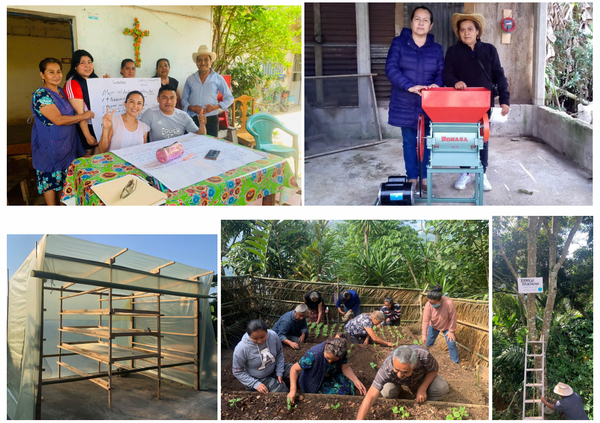
In support of The Chain Collaborative’s 2022-2023 cohort of the Community-Led Development Incubator program, YIELD Coffee supported the second-year participation of Colectivo Rokunín, a community-centered collective in the Sierra de Zongolica of Mexico.
ABOUT COLECTIVO ROKUNIN:
Colectivo Rokunín is a community-centered collective that works alongside coffee growers from indigenous communities in the Sierra de Zongolica of Mexico. They lead projects that centralize art, sustainable agriculture, cultural preservation, and gender equity. The coffee producers collaborating with Colectivo Rokunín named their group “Mahtlaktle Chanehkameh” (“Ten Families" in English), in order to describe their group and honor their Nahuatl heritage.
YIELD Coffee’s support allowed Colectivo Rokunín to carry out the following self-designed project:
Colectivo Rokunín and Mahtlaktle Chanehkameh fully embraced The Chain Collaborative’s Incubator process, conducting community meetings to co-design their project, maintain an open mind to new ideas, and create space for new leaders to emerge. The group ultimately designed a transformative, indigenous-led project to uplift producers through a) investment in their coffee business, and b) preservation of their native language.
First, in the realm of coffee, Colectivo Rokunín conducted soil analyses, provided technical assistance to Mahtlaktle Chanehkameh, and expanded Mahtlaktle Chanehkameh’s processing infrastructure via improved drying beds and new machinery. Each of these elements allowed Mahtlaktle Chanehkameh to improve their coffee quality and achieve higher prices.
Second, in the realm of language preservation, youth in Mahtlaktle Chanehkameh community led an initiative to offer Nahuatl classes for young people to preserve their native language and culture.
BIBLIOTECA GIRASOL, NICARAGUA (2022)

For our 2022 Giveback Project, YIELD Coffee partnered with The Chain Collaborative to provide scholarships and jumpstart a construction fund for a new classroom at Biblioteca Girasol, a community library in Matapalo, Nicaragua.
ABOUT BIBLIOTECA GIRASOL:
Biblioteca Girasol is a youth-led and volunteer-run community library in the rural community of Matapalo, Nicaragua dedicated to expanding educational opportunity, promoting youth leadership and offering a safe space for the community's children to learn and grow. Matapalo is a coffee-growing community of about 500 people in the northern region of Matagalpa, while Biblioteca Girasol is run by two adult community members and a team of 15 youth leader volunteers who organize activities for approximately 100 young children.
YIELD Coffee’s support allowed Biblioteca Girasol to carry out the following self-designed project:
YIELD Coffee assisted in funding a new program designed by Biblioteca Girasol that offered scholarships to students to cover their bus fares and school supplies. In return, scholarship students provided after-school academic support to the children who attend Biblioteca Girasol. This program allowed the library's youth leaders to complete high school, continue giving back to the community, and pursue their goals.
Jubelkys Ramos, one of the library’s youth leaders, noted, "We know that we are helping other young people fulfill their dreams and helping our society move forward. The work we are doing is significant because we have helped families who did not have the opportunity to send their children to school."
In addition to the scholarship program, YIELD Coffee’s support allowed Biblioteca Girasol to start a construction fund to expand their library space, ensuring more after-school activities, and room for larger groups and events.
NOW AFRICA INITIATIVE, UGANDA (2021)

In 2020-2021, YIELD Coffee partnered with The Chain Collaborative to bring clean water and sanitation to a coffee community in southwestern Uganda. The Chain Collaborative is a groundbreaking non-profit organization in the coffee sector that invests in local leaders to drive livelihood developments on their own terms, according to their own visions for change.
ABOUT NOW AFRICA INITIATIVE:
Now Africa Initiative (NAI) is a social enterprise located in the southwestern part of Uganda, in an area called Nyamigoye Parish. In addition to providing market access, training, and increased income to farmers, Now Africa Initiative also manages the Karama Education Center (KEC), a primary school for farmers’ children they founded in 2016 with the support of The Chain Collaborative. Since its opening, due to its popularity and performance, KEC has been steadily expanding its student roster and impact.
YIELD Coffee’s support allowed Now Africa Initiative to carry out the following self-designed project:
As students of KEC returned to school in 2021 after a year of homeschooling in 2020 due to COVID-19, sanitation and hygiene remained paramount. Unfortunately, KEC’s sanitation facilities were built to accommodate only one-third of the student body at the time, as the school started with only 130 students. To meet the growing demand of the 350+ students at KEC in 2021 and ensure positive health outcomes, YIELD Coffee funded sanitation facility expansion at the school (latrine and hand-washing stations), at a critical time when it was needed most.
In addition, YIELD Coffee partnered with The Chain Collaborative and one of their foundation partners, the Conshohocken/Plymouth/Whitemarsh Rotary Club, to launch a coffee fundraiser. Together, YIELD Coffee, CPW Rotary, and TCC raised $5,000 to complete the installation of a solar-powered clean drinking water facility at KEC, bringing both electricity and purified water to the community for the first time.
As a result of these investments, and KEC’s and NAI’s commitment to education, school enrollment increased by 14%, from 350 students in 2021 and 2022 to 405 in 2023.
LA GRECIA, NICARAGUA (2016-2020)

We're honored that together:
YIELD provided modern bathrooms for 3 families in rural Nicaragua in 2017.
YIELD provided modern bathrooms for 4 families in rural Nicaragua in 2018.
YIELD provided modern bathrooms for 4 families in rural Nicaragua in 2019
YIELD provided modern bathrooms for 4 families in rural Nicaragua in 2020.
Thanks to your support, we provided 15 modern bathrooms. Lives were changed for over 75+ people living in La Grecia.
YIELD Coffee partnered with Amigos For Christ to construct modern bathrooms alongside vulnerable families in need. The family is an integral part of the solution producing 10% of the final cost, providing labor, and overseeing the construction. These modern bathrooms include a flushing toilet, hand washing sink, and a shower. These small interventions eliminate parasites that breed in unsanitary latrines infecting family members, especially children.
These simple interventions help end the parasite cycle and significantly reduce preventable intestinal parasites and diarrhea. These modern bathrooms are one of the most cost-effective ways to save lives of vulnerable people.